


The Six Attachment Styles
The six attachment styles are ways we relate to others and see ourself; attachment theory attempts to explain why (the origins).
Published: May 27, 2024
Reviewed: October 17, 2025
What is attachment
Consider the word relationship. Merriam-Webster defines it as "the state of being related or interrelated."
A state of being. Remember that as you keep reading.
Attachment is a psychological framework for understanding relational bonding that begins between parents and children and continues through one's life. The six attachment styles are ways we relate to others and see ourself; attachment theory attempts to explain why (the origins).
We each developed a particular attachment based on the level of developmental support (or lack of) by our primary caregivers. As adults, we continue to view the world and relate to others through this lens. Our attachment shapes:
(1) the way we relate to others, and
(2) how we relate to ourself.
"You become how people see you."
Bessel van der Kolk
In a marriage, there is also a third to consider: the relationship itself. It's existence is established by an emotional bond—the state (or condition) of two souls together. Attachment also (3) affects how we posture toward our relationships.
For couples in recovery, there are three in need of healing: the struggler, the partner, and the relationship.
Credit to the sages
I am writing this article to help my clients further understand the attachment "triangle" that I often talk about in sessions. I refer to the wisdom from another attachment and relationship source. I give them credit for their wonderful insight.
- Milan & Kay Yerkovich
Milan and Kay created Attachment Core Pattern Therapy™ and authored How We Love. Their book is one of the single most important resources in my and my wife's personal and relational recovery. As our go-to authority, it is currently the only book that is placed on both our addiction recovery and betrayal healing recommended reading lists. Yes, it's that big of a deal.
Six attachment styles
have 6 relational patterns
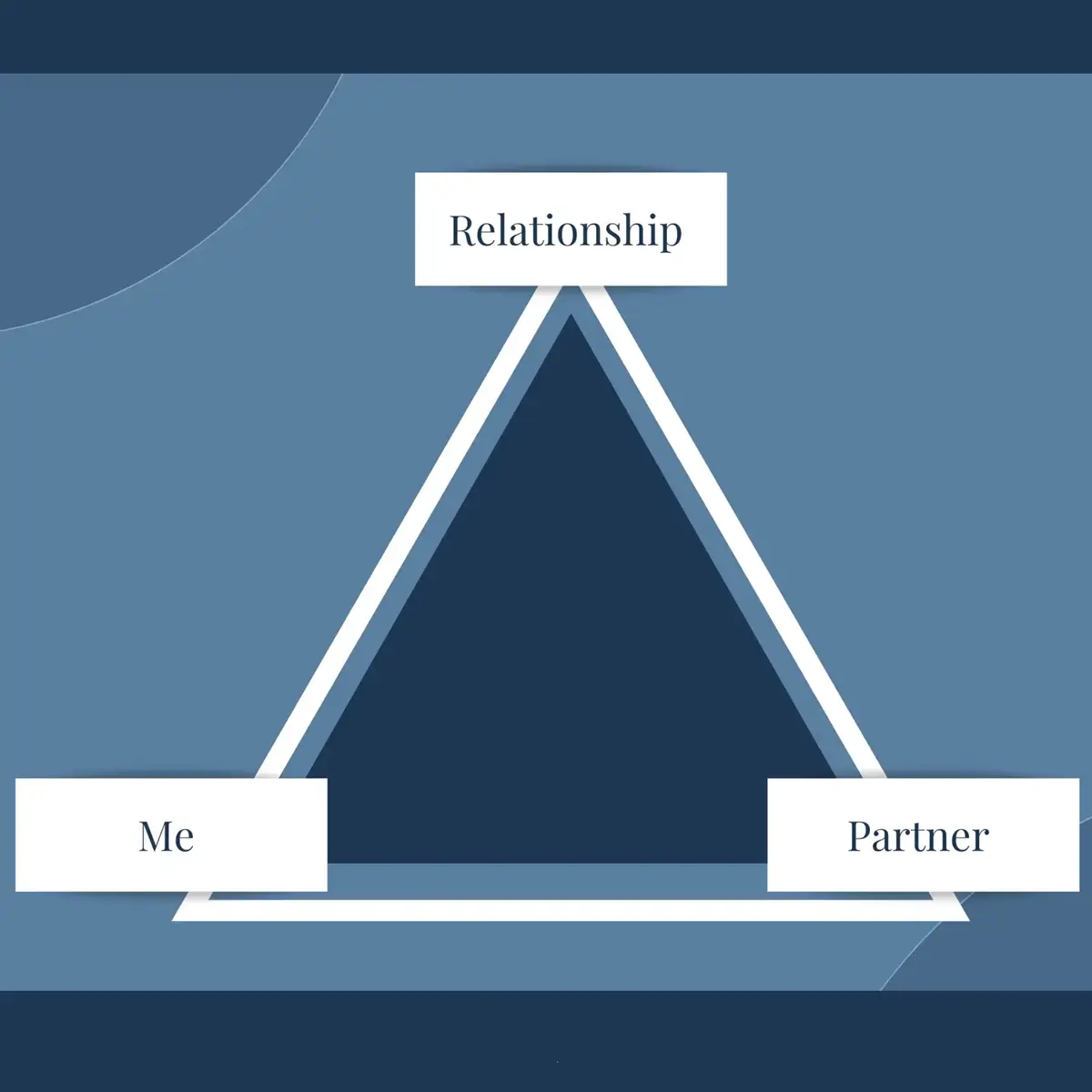
The Yerkoviches introduced the idea of six Love Styles referred to as the Avoider, Pleaser, Vacillator, Controller, Victim, and the Secure Connector. Using a triangular construct, I present them by the way a person relates to oneself, a partner, and the relationship—each style represented by the corners of the triangle. My attachment triangle is an attempt to expand the Yerkoviches' Love Styles in a visual way.
Imagine the triangle was placed in front of you (reference the image slider below). I will explain attachment by you figuratively placing your hands on the corners of the triangle. The yellow highlighted boxes represent hand placement. You only have two hands so there can only be six different patterns. Six styles, six relational patterns.
Scroll horizontally
-
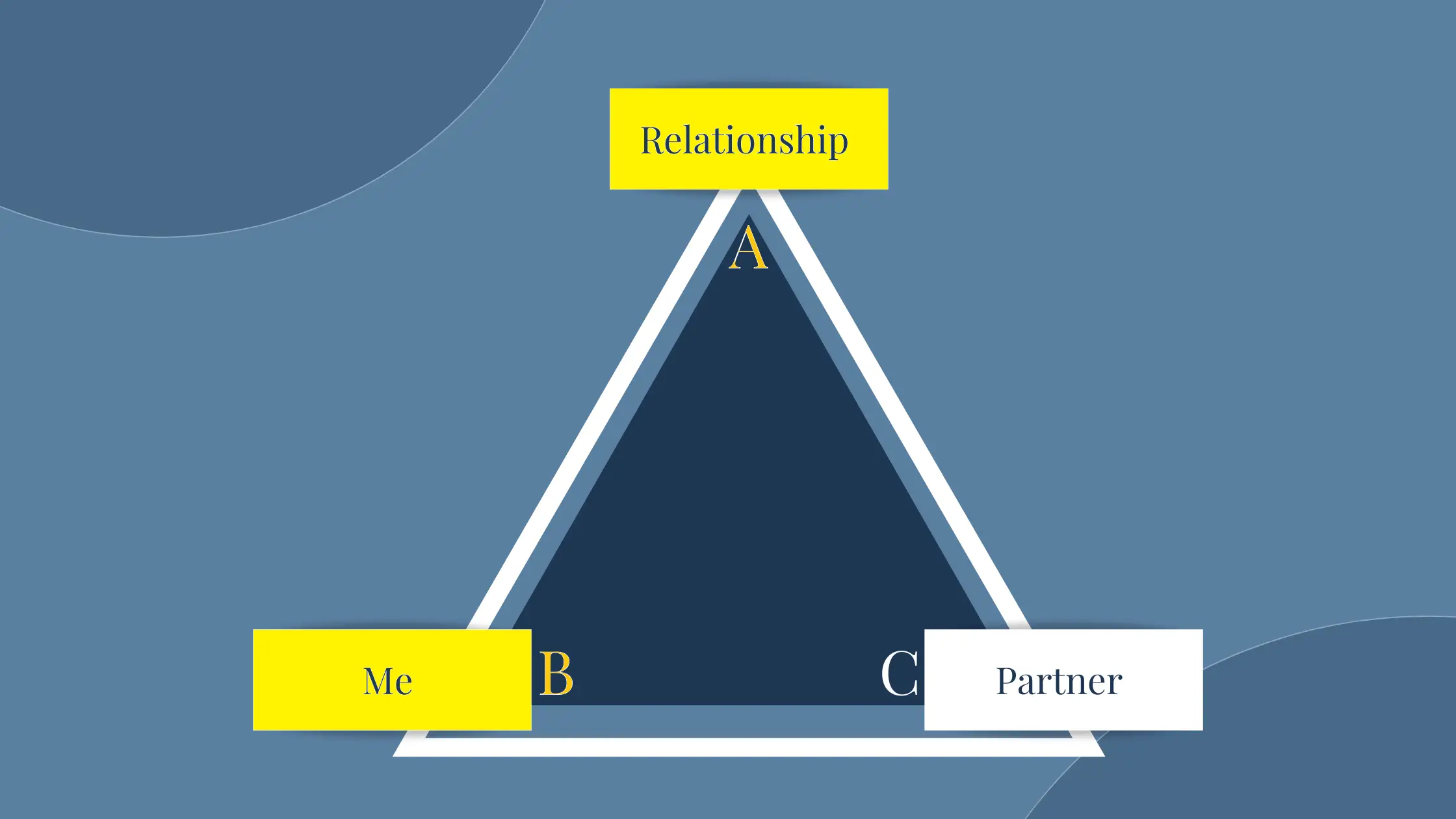
Secure Connector
One hand on the Me corner, the other hand on the Relationship corner.
-

The Vacillator
Both hands are placed on the Relationship corner of the triangle.
-

The Pleaser
One hand on the Partner corner, the other hand on the Relationship corner.
-
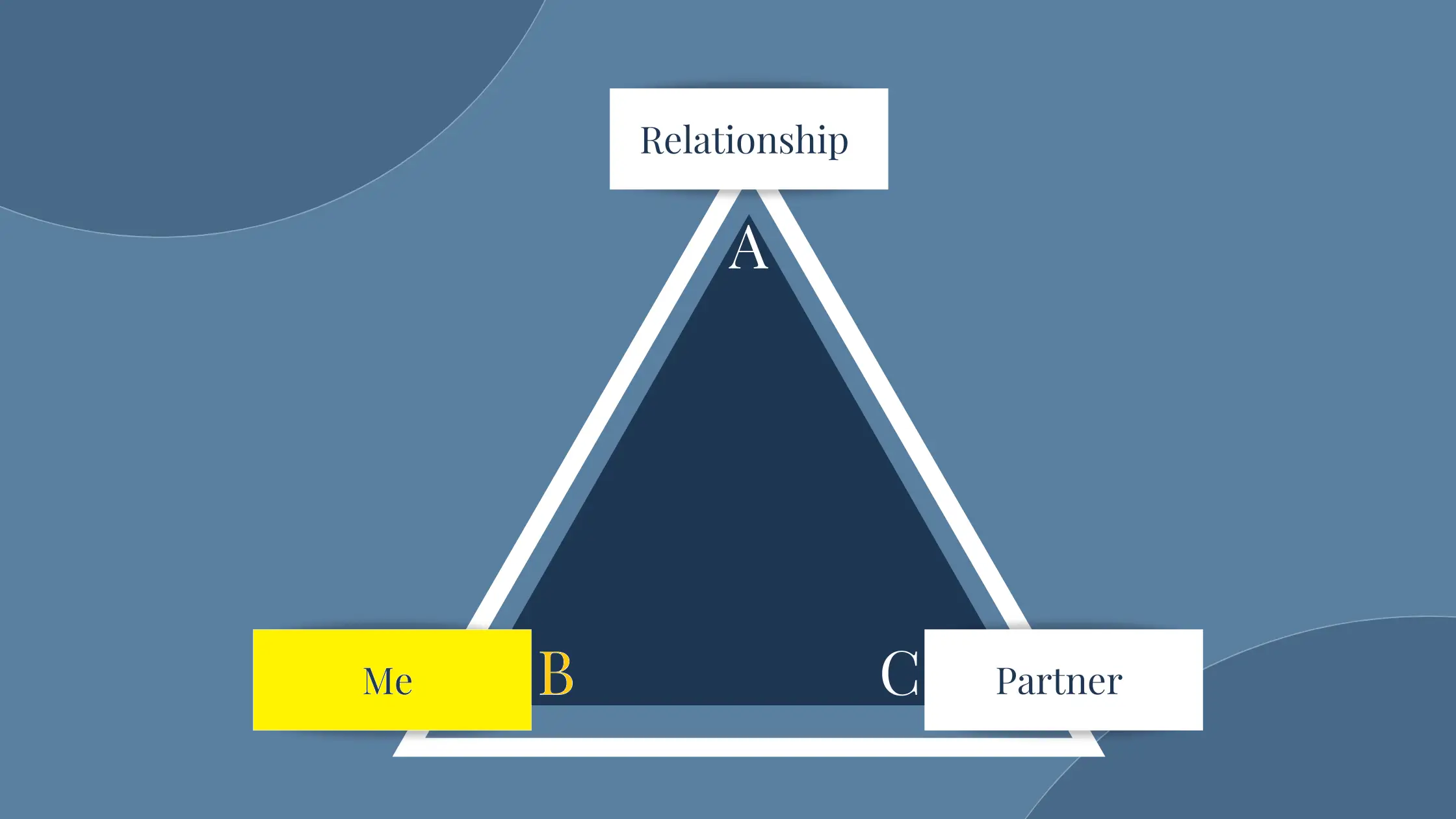
The Avoider
Both hands are placed on the Me corner of the triangle.
-

The Controller
Both hands are placed on the Partner corner of the triangle.
-
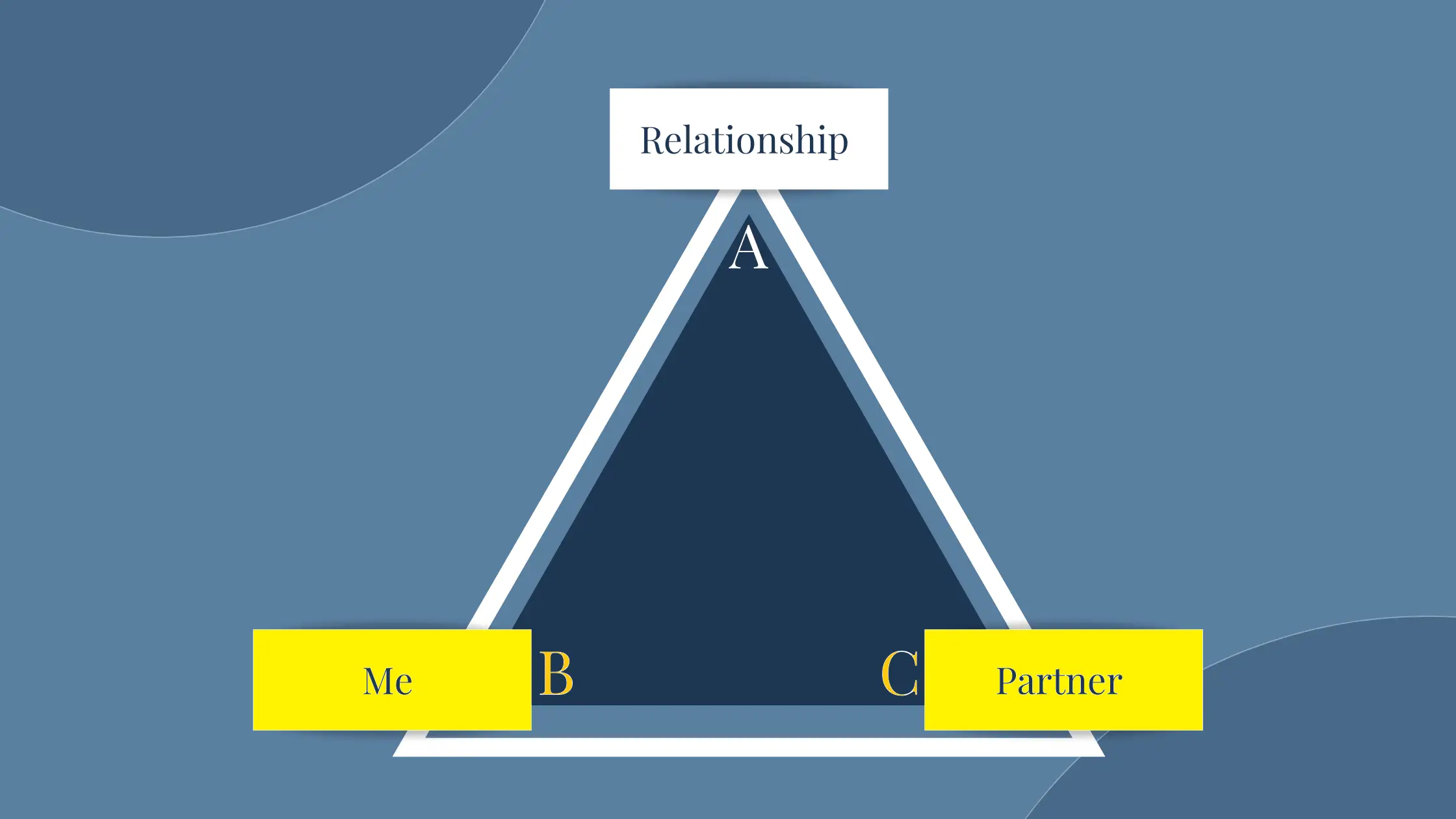
The Victim
One hand on the Me corner, the other hand on the Partner corner.
Attachment descriptions
For each Love Style briefly described below, yellow highlighted boxes (hand placement) in the corresponding triangle indicates your attentive focus. Don't presume that one's attention is done well. Focused attention on your partner or yourself could be healthy or unhealthy.
Since all styles (excluding the Secure Connector) are born from relational wounding, it's a sure bet they rely on insecure connection and don't know how to relate well. Their attention could be to serve a need other than love, such as safety. For instance, unhealthy attentive focus on Me could present as intentional relational disconnection or even directed self-blame, as you will see below.
Secure Connector (A•B)
In a healthy attachment, these people attend to their own needs and the needs of the relationship. They don't make the mistake of presuming their role is to take agency of their partners. They were modeled valuable traits in their formative years, such as interdependence, trust, and respect. They were loved and accepted for being themselves, wholly recognized and seen, and allowed to express their emotions. They don't fear relational discord, knowing it is only a temporary state before resolution.
The Vacillator (A•A)
Probably the most difficult style to understand—and I say that being one. Vacillators are not good stewards of themselves, lacking a sense of Self without another. Their sole focus is maintaining an idealized relational arrangement while warding off fear of rejection. Vacillators are named for the ambivalent swings of seeking connection and disconnection, and their partners become exhausted from the emotional tug-of-war. Anger is a Vacillator's most common defense.
The Pleaser (A•C)
Pleasers live a life of anxiety and unmanaged empathy. While others are drawn to their attunement and selflessness, this self-sacrifice of their own desires and agency to keep others happy serves as a pursuit of safety. Pleasers tend to be unaware of their feelings because they are so heavily invested in how others are feeling. Unlike Vacillators, anger is an undeveloped emotion because it risks fracturing carefully attended relationships. Fawning is a common strategy.
The Avoider (B•B)
Avoiders find comfort in aloneness. Like their name implies, they tend to avoid situations that may elicit strong emotions. Emotional engagement creates internal tension and seclusion allows for self-regulation. This disconnection has a trade-off: they have difficulty giving language to their feelings. They compensate with self-sufficiency and independence. Avoiders value competence and they have a high tolerance for stress. Generally even-tempered, anger is a rare last resort when cornered with no other options.
The Controller (C•C)
Also a poor steward of Self, the Controller is a product of chaos—enduring a traumatic or authoritarian environment in their formative years that taught "control or be controlled." Often survivors of conflict and abuse, they have a low tolerance for weakness in themselves and others. Controllers use anger (or rage) to keep their vulnerable emotions below the surface as well as to intimidate their partners. They are likely to initiate an argument over a perceived threat to their dominance.
The Victim (B•C)
Also developed in chaotic environments, Victims learned survival through submission rather than control. Appearing as an extreme Pleaser, a Victim's life is an existence of peril and their relational role may feel like servitude. Their partners are often a source of fear and threat, so they expend substantial energy trying to keep their partners appeased. This includes accepting blame and working harder at fixing themselves to "get it right." Like magnets, Controllers and Victims tend to find one another and strike up a turbulent union.
Attachment quiz
The Yerkoviches offer an online quiz to help discover your Love Style. It's called the Love Style Quiz. I invite you to take the quiz but there are a few things to know about it before you start.
- When you register, it will ask you which quiz you want to take. There are two choices and they don't really convey their intent well. The questions are framed based on the test-taker's perspective:
- For Singles: this means you will be answering the questions for yourself.
- For Married: this means you will be answering the questions for your partner.
- I don't recommend trying to answer for your partner—the For Married option. Many questions are about how we relate to our experiences and we simple can't know how anyone else relates to their own world. There's little chance the results will accurately reflect anyone other than yourself.
- Some questions seem vague and repetitive. It's best to frame the questions around specific events in your life. Doing that can give them more clarity. Ponder them well.
- After the quiz is scored, you will receive a numeric score for each of the Love Styles. You should have higher scores in some styles and lower scores in others. That's normal. I focus only on the two styles with the highest scores. If those two numbers are close, I recommend taking the quiz again until one style definitely stands out higher than the rest.
Let me know your two highest scoring Love Styles. I can explain what it means for you and your relationship. Knowing your scores, I can also provide additional documentation that helps explain your conflict patterns, intervention methods, and personal growth steps toward a more secure attachment.
Understanding how and why you relate to others is essential to your personal recovery. Also, understanding the relational dynamic between your Love Style and your partner's Love Style is essential for your relational recovery. The Yerkoviches cover all this material in their must-read book, How We Love. I recommend the book and workbook combo.
Tony is co-founder of Oak Mountain Coaching, an online practice that helps men regain their sexual integrity from the throes of active addiction and helps their partners heal from betrayal trauma.
-

The Root Cause of Addiction
A cycle of shame at the root cause of addiction cannot be remedied with quick fixes, expert tips, or a checklist.
-

The Opposite of Addiction
Men with addiction are stuck in a cycle of compulsion and secrets. Trying to hide and fight it alone only serves to feed the addiction.
-

Greatest Fear of Recovery
Fear is a powerful force. An innate survival skill, it keeps us in loneliness by taking the choice of relationship away from others.
-

Addiction Slips vs Relapse
Slips and relapse describe falling short of sobriety in one's recovery. Let's examine what they can mean for you.
-

Three Circles Exercise
The Three Circles is a recovery exercise for sexual sobriety that defines behaviors related to a struggler's addiction.
-
How Porn Harms
Telling yourself, 'It's not hurting anyone' is wishful thinking. Research shows it affects your brain and everyone around you.
-

Why Am I Addicted to Porn?
Discover how internalized shame fuels porn addiction and identify hidden emotional patterns with our internalized shame test.
Scroll horizontally
Join our Substack
Get recovery and healing insights delivered right to your inbox.
