


SAA Three Circles for Addiction Recovery
The Three Circles is an SAA recovery tool for defining sexual sobriety behaviors related to a struggler's addiction.
Published: January 19, 2023
Reviewed: April 27, 2026
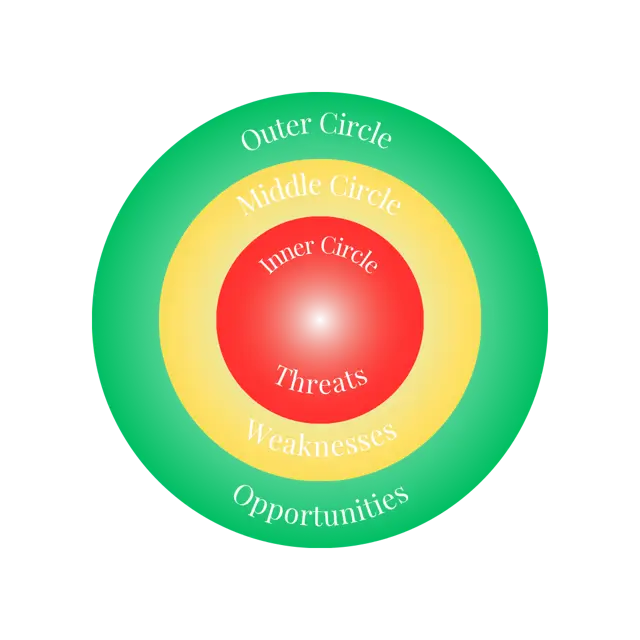
Three Circles Worksheet and Example
Sex Addicts Anonymous is the originator of this recovery tool and they have posted the worksheet for the public. Download it here and read the rest of this article for additional insight on how to complete it.
Need ideas for your circles? Our example PDF worksheet shows what a finished result looks like and offers ideas on what to include in yours. It's free, too.
Three Circles Exercise
The Three Circles exercise is a personal recovery framework used by strugglers to define sobriety, recognize risky behaviors, and identify healthy recovery behaviors through three self-defined categories: inner, middle, and outer circles.
For this exercise, think of it as similar to SWOT analysis. Also called a SWOT matrix, it's a business framework for strategic planning that evaluates the internal and external factors in a competitive environment. The internal factors are Strengths and Weaknesses, and the external factors are Opportunities and Threats.
The Three Circles is much like SWOT in that pursuing sobriety necessitates a plan. Any good plan begins with identifying objectives within a framework of the same internal and external factors. That's the point of the Three Circles Exercise: identify your strengths, weaknesses, opportunities, and threats.
Identifying your strengths may be difficult. People who struggle with compulsive porn use and sex addiction struggle with a negative self-concept. It can be challenging to self-assess one's strengths in character when burdened by a strong negative belief system. Let's use an outside resource to aid in this endeavor.
The VIA Institute, originally meaning Values In Action, produced an online survey to help people assess their character strengths. In their words: "When you discover your greatest strengths, you can use them to face life’s challenges, work toward goals, and feel more fulfilled both personally and professionally."
Subscribe to
Insights for Recovery and Healing
83% of relapses...
are due to unregulated emotions. Subscribe to our Substack for insights on this aspect of addiction recovery.
SAA Outer Circle
(Opportunities)
The outer (green) circle lists healthy behaviors that put a struggler on a path toward who he wants to be. They are life-enhancing and include activities helpful for managing stress. Naturally, engagement in counseling/coaching, a support community, sponsor, and accountability partners are healthy recovery activities. Try starting your list from a holistic perspective (mental, emotional, physical, spiritual, and social). Community is social, and so is sports. Sports is physical, too, as is any fitness regime.
I cannot overstate the importance of the outer circle. This is where you define who you want to be by aligning your actions to your desired value system (and using your character strengths to help achieve your goal). Contest your negative belief system through habitual practice of these healthy behaviors even if it feels counterintuitive.
SAA Inner Circle
(Threats)
Defining sobriety is central to recovery. This is where it's done. The inner (red) circle lists behaviors you want to stop. It could be porn, voyeurism, prostitutes, affairs, ... whatever are your personal sexual obsessions that you want to stop.
It should go without saying, I encourage you to involve your sponsor or coach in each circle—especially this one. It's not uncommon for strugglers to take it easy on themselves when making this list, or to even be aware of the threats that exist.
SAA Middle Circle
(Weaknesses)
The middle (yellow) circle is tricky. It represents the sliding slope that eventually leads to the inner circle. It's important to identify these behaviors so you can see the danger when they present themselves. Case in point... workouts at a gym are good for our physical fitness, but using it as a place to sexually objectify others take us down the wrong path. If the gym isn't safe, it's a middle circle and best to be avoided. If the gym is a place of prior acting out, it's an inner circle.
It's normal to have questions when developing your circles. Run them (and any later changes) by your sponsor or coach. Don't change your circles out of convenience.
A disciplined recovery begins with identifying your internal triggers, external triggers, and rituals so you can recognize them as warning signs before they lead to slips and relapses. A recovery coach can help analyze your middle circle behaviors for this purpose and explain how they relate to your emotional wellbeing.
Strugglers typically have underdeveloped emotional awareness skills, so they often miss the internal cues—their feelings and emotions—of dysregulation. Simply put, addictive behaviors are attempts at managing internal distress with external resources. So, it's crucial to know the signs of your own internal triggers.
Strugglers tend to have more awareness of their external, environmental triggers: the people, places, or events that introduce sexual thoughts or urges. It's common for them to repeat or ritualize a pattern of activity in this environment that leads to acting out (finding a reason to visit the gym at a certain time of day, for instance.)
Lastly, the Three Circles is an exercise in honesty. Don't give yourself wiggle room for a later slip excuse. Do the right thing now so your future self isn't penalized.
Trying to quit porn?

Let a trained expert with the lived experience of addiction recovery show you how.
Tony is co-founder of Oak Mountain Coaching, an online practice that helps men regain their sexual integrity from the throes of active addiction and helps their partners heal from betrayal trauma.
-
The Root Cause of Addiction
A cycle of shame at the root cause of addiction cannot be remedied with quick fixes, expert tips, or a checklist.
-

The Opposite of Addiction
Men with addiction are stuck in a cycle of compulsion and secrets. Trying to hide and fight it alone only serves to feed the addiction.
-

Greatest Fear of Recovery
Fear is a powerful force. An innate survival skill, it keeps us in loneliness by taking the choice of relationship away from others.
-

Addiction Slips vs Relapse
Slips and relapse describe falling short of sobriety in one's recovery. Let's examine what they can mean for you.
-

Three Circles Exercise
The Three Circles is a recovery exercise for sexual sobriety that defines behaviors related to a struggler's addiction.
-

Why Am I Addicted to Porn?
Dr. Gabor Maté explains, 'The addiction wasn't your problem. Your addiction was your attempt to solve a problem.'
-
How Porn Harms
Telling yourself, 'It's not hurting anyone' is wishful thinking. Research shows it affects your brain and everyone around you.
Scroll horizontally
Join our Substack
Get recovery and healing insights delivered right to your inbox.
