


The Feelings Wheel & Science of Emotions
Many people are disconnected from their feelings. It is necessary to become aware of, and regulate, their internal state.
Published: January 23, 2023
Reviewed: November 14, 2025
The Feelings Wheel
"What you resist persists." –Carl Jung
Many people are not aware they are generally disconnected from their feelings and emotions. Losing self-awareness is a by-product of the emotional "armor" they use to protect themselves from vulnerability. No one can get close to their heart (self-protection), but neither can they themselves.
Consider a "How are you?" greeting. If your typical response is
- I'm good
- I'm fine
- I'm okay
then your answer is not reflecting a true awareness of well-being.1 Here are a few other characteristics to consider:
- Difficulty expressing empathy
- Difficulty managing conflict in a positive way
- Engaging in unhealthy relationships
- Confusing physical and emotional intimacy
- Self-aware of only a few emotional states
These are signs that you have some work to do. This phenomenon—lacking the ability to identify, regulate and communicate emotions—has a name: alexithymia. Have you heard of it? Common characteristics include being challenged by empathy and often resist revealing your feelings. Like strengthening a muscle, it's going to take time and effort to build emotional awareness. The Feelings Wheel can help.
Find out if you have alexithymia
Feelings Wheel pdf
This Feelings Wheel exercise will take time (it took me about 3 months practicing daily), but it is necessary to become aware of, and regulate, your internal state. It is especially necessary for you to develop emotional intimacy and empathy for your partner.
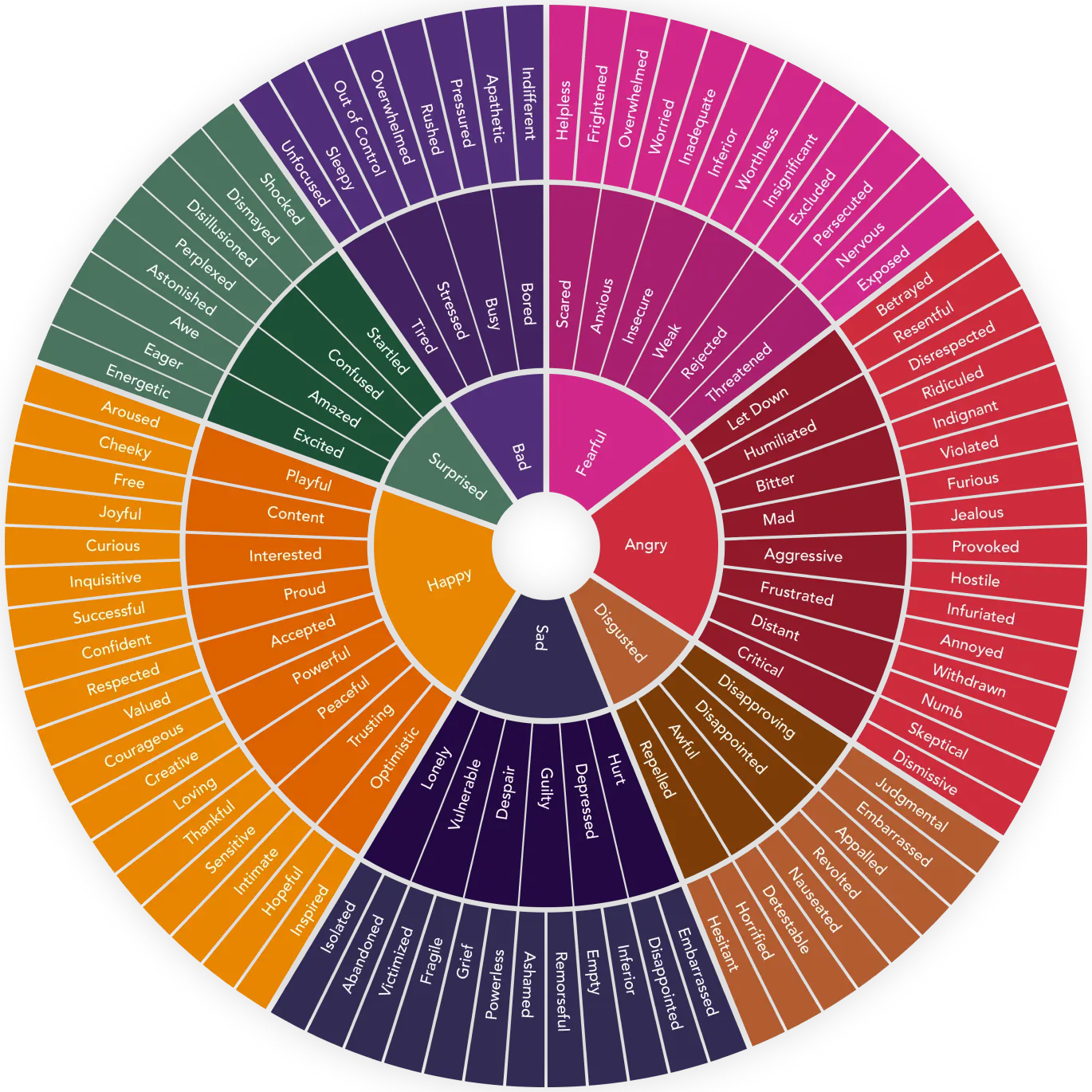
You can find many feelings wheels by a simple web search. Choose one or use the image here. I like this one because it has so many selections.2 Download and save the wheel image to your phone's Photos or, even better, set it as your Lock Screen image. Whenever you open your phone, the image will remind you to check-in with yourself to ask, "How am I feeling in this moment?"
How to work the wheel
How are you feeling?
The primary goal of this exercise is to give your feelings a voice.
Begin in the center. Find the word that best represents how you feel inside. Notice the center choices are very general. It's usually easier to identify five main feelings: mad, sad, glad, afraid, and lonely. The purpose of the wheel is to start with one of those and work toward an outer edge of the circle. Doing so will reveal specificity and allow you to give language to your emotions.
As an example, let's say in the present moment you are afraid. Starting from "Fearful" in the center, move one step outward to the next six feelings. Which of the six feels more closely aligns with your fear? Choose threatened, rejected, or one of the others. From there, narrow down the specificity by choosing a word along the outer edge. If rejected, are you feeling excluded or persecuted?
For the exercise, share your discovered feelings with someone you trust throughout the day. This is not easy. I can attest. But I learned a way to help. Instead of saying, "I feel ________", put the feeling at the end of a sentence for an event that occurred. Our feelings tend to naturally roll out this way:
I got into an argument with our neighbor after work and now I'm feeling kind of bad about it.
Getting unstuck
Having trouble recognizing a base feeling? Here's a tip: make the sound. The first sound that comes to you. That's the sound of the feeling that seems unrelatable. Use it to guide you.
Subscribe to
Insights for Recovery and Healing
83% of relapses are due to unregulated emotions and relational problems. Subscribe to our Substack for insights on this aspect of addiction recovery.
Avoid self-judgment
Like feeling good1, feeling bad is often a self-judgment. Use the feelings wheel to narrow down the specificity of the emotion. Could you be tired or stressed after a long day at work, especially after an unresolved confrontation? Select a word from the Wheel that best fits the situation (or choose your own). Keep clarifying your feeling to find its root as you work toward the edge of the circle.
Bad » Stressed » Overwhelmed
The feelings wheel can help you discover underlying, concealed emotions. In our example, maybe you didn't realize you were stressed and overwhelmed all day, and now you are simply exhausted. We need to identify the emotions that we tend to dismiss for some semblance of control. Now honor that feeling by voicing it out loud so you can hear yourself saying it:
It's no wonder why I got into an argument. I've been overwhelmed all day at work. I'm exhausted!
Feelings are never wrong (it's not like we get to choose them), but we're still responsible for our actions and any harm they cause.
Additional thoughts on anger and anxiety
Anger
When anger is frequently the first—or default—emotion that arises, it may be best described as a numbing emotion because it helps us not feel deeper, more vulnerable feelings. Anger makes us feel powerful and more in control. It can cover up fear or sadness because we often want to avoid those two emotions. It can also cover shame. Look below the surface, by setting anger aside, to reveal the true primary emotion if you are feeling angry or resentful. Then follow the primary emotion on the Wheel and narrow down its specificity.
Anxiety
Like anger, anxiety is also common and it covers other emotions, too. While the Wheel shown in this article lists "anxious" as a subset of fear, anxiety and fear are considerably different. Fear has a basis in a real or perceived threat. Anxiety is a felt experience when you are avoiding other important unfelt emotions. It can cover many emotions, but I invite you to consider whether it is covering a primary emotion of anger. In this case, anger that does not surface first is not a default emotion; you may be suppressing it.
The science of emotions
UCLA psychologist Matthew Lieberman conducted a study using MRI imaging to understand why talking about our emotions tends to make us feel better. His study revealed that emotional centers in the brain appeared to calm when the participants labeled negative emotions. I've provided the link below to a scientific article that talks about his study.
Naming (or labeling) our emotions allows congruency between the thinking part of our brain and the feeling part of our brain. You may know this as left brain and right brain. In other words, we can immediately reduce the intensity of strong emotions simply by naming the emotion. Isn't that great news! Just remember, some emotions like anger and anxiety tend to cover the real primary emotions that we need to name.
1Good is not a feeling; it's a judgement. A secondary goal of this exercise is to learn self-compassion. Judge less and be kind to yourself. Please take a moment to read this article titled "Good" is Not a Feeling.
2One of my few complaints of this Feelings Wheel is that it lists "Bad" as an emotion. Both good and bad are judgments. A better choice of words would be: off or unwell.
Tony is co-founder of Oak Mountain Coaching, an online practice that helps men regain their sexual integrity from the throes of active addiction and helps their partners heal from betrayal trauma.
-

The Root Cause of Addiction
A cycle of shame at the root cause of addiction cannot be remedied with quick fixes, expert tips, or a checklist.
-

The Opposite of Addiction
Men with addiction are stuck in a cycle of compulsion and secrets. Trying to hide and fight it alone only serves to feed the addiction.
-

Greatest Fear of Recovery
Fear is a powerful force. An innate survival skill, it keeps us in loneliness by taking the choice of relationship away from others.
-

Addiction Slips vs Relapse
Slips and relapse describe falling short of sobriety in one's recovery. Let's examine what they can mean for you.
-

Three Circles Exercise
The Three Circles is a recovery exercise for sexual sobriety that defines behaviors related to a struggler's addiction.
-
How Porn Harms
Telling yourself, 'It's not hurting anyone' is wishful thinking. Research shows it affects your brain and everyone around you.
-

Why Am I Addicted to Porn?
Discover how internalized shame fuels porn addiction and identify hidden emotional patterns with our internalized shame test.
Scroll horizontally
Join our Substack
Get recovery and healing insights delivered right to your inbox.
